
Leadership is often described in uplifting language – vision, inspiration, empowerment. In reality, it feels far less polished.
It feels like making a decision when every option disappoints someone.
It feels like carrying responsibility without having full control.
It feels like asking people to change when you are not entirely certain what the end state will look like.
Across sectors (corporate, nonprofit, public, entrepreneurial) leadership today is less about control and more about navigating uncertainty. And that is where transformational and adaptive ideas become practical rather than aspirational.
Integrity – Tested Under Pressure
We often say leadership begins with integrity. It is an easy statement to agree with, but a much harder one to live out.
Kouzes and Posner’s Model the Way makes a useful distinction: values only matter when they shape behaviour. Transformational leadership makes a similar argument through idealized influence. Leaders build credibility not by talking about what they believe, but by making those beliefs visible in the choices they make.
The difficulty is that leadership rarely presents us with clean choices. There are competing priorities, limited resources, organisational politics, deadlines, stakeholder expectations, and people who can be affected very differently by the same decision. Sometimes there is no option that feels entirely right. Sometimes the decision that is right for the organisation in the long term is the one that creates discomfort in the short term.
This is where integrity becomes difficult and where it matters most. It does not tell us what the right decision is, but it asks us to consider whether the choices we make are consistent with what we say we value, particularly when circumstances make that consistency difficult.
It also means accepting that leadership inevitably involves judgement, and judgement is rarely perfect. We will misread situations, underestimate consequences, and occasionally make the wrong call. What matters for trust is not the illusion of moral certainty, but whether people can see that there is something more durable behind our decisions than convenience, pressure, or self-interest.
In that sense, integrity is less about having a perfect set of answers and more about having a clear centre from which to make difficult choices.
Vision Without Ownership Fails
Leaders are told to inspire. To paint a compelling future. To energize others.
But vision alone does not create change.
What often gets overlooked is what Ronald Heifetz calls the difference between technical and adaptive challenges. Technical problems can be solved with expertise. Adaptive challenges require people themselves to change – their habits, assumptions, loyalties, even parts of their identity.
That is why so many strategic visions stall. Not because the idea is flawed, but because the human cost of change is underestimated.
You cannot simply announce transformation. You have to create conditions where people wrestle with it, question it, resist it, and gradually take ownership of it.
This is where Kouzes and Posner’s idea of Enabling Others to Act and transformational leadership’s individualized consideration become practical. Leadership is not delivering answers. It is distributing responsibility.
Real transformation happens when people see themselves in the change, not when they are told to comply with it.
Innovation Is Disruptive – Even When Necessary
We celebrate innovation, but we rarely acknowledge what it destabilizes.
Challenging the process, whether through new systems, new strategies, or new cultural norms, threatens competence, status, and familiarity. Intellectual stimulation sounds positive in theory. In practice, it introduces uncertainty.
Heifetz argues that effective leaders regulate distress. Too little pressure, and nothing moves. Too much, and the system shuts down.
This is the tension leaders live inside: pushing enough to create movement, but not so much that trust fractures.
There is no formula for this. Only judgment, attentiveness, and the humility to adjust when you miscalculate.
Leadership Is Work – Not Identity
Perhaps the most clarifying idea across these frameworks is that leadership is not a personality type. It is a practice.
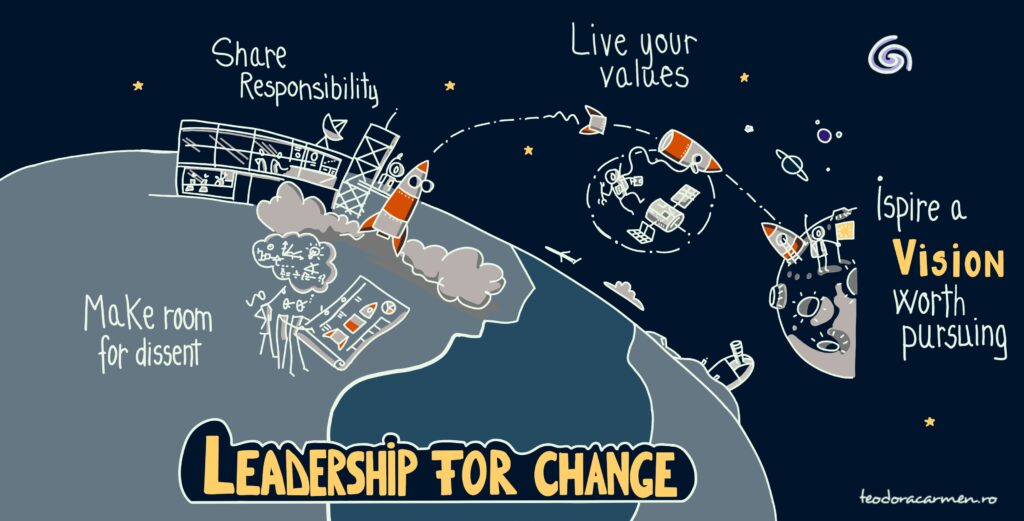
You do not become a leader because you are charismatic, confident, or visionary. You exercise leadership when you:
- Align actions with values, even under pressure.
- Invite people into a future that requires effort, not just enthusiasm.
- Create space for dissent instead of silencing it.
- Share responsibility rather than accumulating control.
And you will not do this perfectly.
Leadership involves disappointing people. It involves trade-offs. It involves moments where outcomes fall short despite good intentions.
What makes it transformational is not perfection. It is persistence – the willingness to stay engaged in the discomfort of meaningful change.
In closing…
Leadership is the disciplined practice of helping people move through uncertainty without losing coherence, capacity, or trust.
And that is neither idealistic nor simple. It is difficult, imperfect and necessary work.